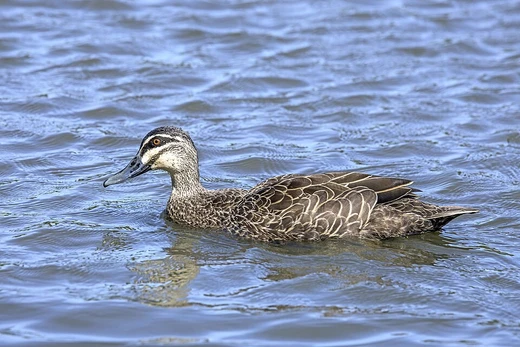
Pink-footed shearwater
A vulnerable seabird of the Pacific, known for its pink bill.
The pink-footed shearwater (Ardenna creatopus) is a species of seabird in the order Procellariiformes. It is a pelagic, transequatorial migrant that breeds on offshore islands off Chile, such as Mocha Island, and migrates to subarctic Pacific waters. The species is notable for its polymorphic plumage, with darker- and lighter-phase populations, and its close relationship to the flesh-footed shearwater, with which it forms the Hemipuffinus group.
- length
- 48 cm (19 in)
- wingspan
- 109 cm (43 in)
- conservation_status
- Vulnerable (IUCN Red List)
- breeding_range
- Offshore islands off Chile (e.g., Mocha Island, Juan Fernandez Archipelago)
- migration
- Transequatorial migrant to subarctic Pacific and West Coast of the United States
- diet
- Mainly fish, squid, and crustaceans
Lore & Background
The pink-footed shearwater nests in burrows on forested slopes, forming colonies. Its numbers have been reduced by predation from introduced species such as rats and cats, as well as entanglement in fishing gear. The species is one of those covered by the Agreement on the Conservation of Albatrosses and Petrels.
A molecular phylogenetic study published in 2021 found very little genetic difference between the pink-footed shearwater and the flesh-footed shearwater, leading the authors to suggest they might be considered conspecific. However, the American Ornithologists Union largely considers them two separate species, close enough to be a superspecies.
Breeding behavior is poorly known, but like other Procellariiformes, pink-footed shearwaters are likely socially monogamous. They are mainly active at night, and partners have been observed resting together in burrows, softly calling in duet and preening each other's head and neck.
Reader's Guide
The pink-footed shearwater is significant as a vulnerable species with a limited breeding range, making it susceptible to stochastic events and human impacts. Its conservation status highlights the threats faced by seabirds from introduced predators and fishing gear. The species also illustrates taxonomic uncertainty in seabird classification, as genetic studies suggest it may be conspecific with the flesh-footed shearwater. Its transequatorial migration of up to 31,000 km demonstrates the extensive movements of pelagic seabirds, and its foraging preferences for high-salinity waters with surface temperatures between 14 and 18 degrees Celsius tie it to specific oceanographic conditions. The pink-footed shearwater's dual foraging strategy, alternating short and long trips, reflects a compromise between chick provisioning and adult body maintenance. Its presence off the West Coast of the United States during warmer months makes it a familiar sight to North American birders, while its breeding colonies in Chile are vulnerable to introduced predators. The species is a subject of ongoing research into movement ecology and the effects of climate shifts on speciation.
Did You Know?
- The pink-footed shearwater is polymorphic, having both darker- and lighter-phase populations.
- A 2021 molecular phylogenetic study found very little genetic difference between the pink-footed shearwater and the flesh-footed shearwater.
- It performs transequatorial migrations of up to 31,000 km from its breeding sites in Chile.
- The species is one of those covered by the Agreement on the Conservation of Albatrosses and Petrels.
More in Birds of the Pacific Ocean 1-24
Spotted an error? Know more?
This is a living reference — every entry is fact-audited, and reader corrections feed straight into our audit queue. Suggest an edit · See this site's audit record