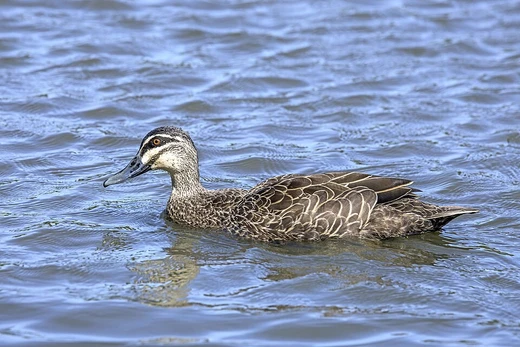
Gould's petrel
Seabird named after John Gould, breeds off Australia and New Caledonia.

Wikipedia / Wikimedia Commons
Gould's petrel (Pterodroma leucoptera) is a seabird from the family Procellariidae. Its name honors the English ornithologist and bird artist John Gould (1804–1881). This bird is a small gadfly petrel, with white underparts and dark brown and grey upperparts. Across its upper wings, it shows a dark M-shaped pattern, a feature shared by all members of the subgenus Cookilaria. It has long, narrow wings, a short, rounded tail, and a noticeably dark head with a white forehead and face. Adults measure 30 cm in length, have a wingspan of 70 cm, and weigh between 180 and 200 g, with males being slightly larger than females.
The species includes two subspecies. The nominate subspecies (Pterodroma leucoptera leucoptera) breeds mainly on Cabbage Tree Island (John Gould Nature Reserve) and a few other small islands off the coast of New South Wales, Australia. The other subspecies (P. l. caledonica) breeds on New Caledonia. Compared to the nominate form, it is slightly larger, has a more robust bill, a paler back and breast sides, less pigmentation on the underside of the wing, and a white or mostly white inner vane on the outer tail feather. Some experts consider the collared petrel (P. brevipes) a third subspecies of Gould's petrel, while others treat the New Caledonian petrel as a separate species, grouping all three as a superspecies.
Gould's petrel is also called the white-winged petrel, but because other related gadfly petrels have much more white on the underwing, the name "Gould's petrel" is preferred. This name was chosen by W.B. Alexander in his book *Birds of the Ocean*. John Gould first described the bird in 1844, naming it Cook's petrel (Procellaria cookii) after James Cook. In his 1865 *Handbook*, he changed the name to white-winged petrel (Aestrelata leucoptera). Today it is known as Gould's petrel (Pterodroma leucoptera).
These petrels spend most of their lives at sea, coming ashore only to breed. Before the 1990s, the Australian subspecies was thought to breed only on Cabbage Tree Island. After breeding pairs were found on nearby Boondelbah Island, 200 chicks were moved there in 1999 and 2000, establishing a small satellite colony that uses artificial nest boxes. In December 2009, just one month after rabbits were removed from Cabbage Tree Island, a single Gould's petrel was found incubating an egg on another nearby island, Broughton Island. Today, t
- Scientific name
- Pterodroma leucoptera
- Family
- Procellariidae
- Length
- 30 cm
- Wingspan
- 70 cm
- Weight
- 180–200 g
- Subspecies
- 2 (P. l. leucoptera, P. l. caledonica)
- Conservation status
- Vulnerable (New Caledonian subspecies)
Lore & Background
Gould's petrel was first described by John Gould in 1844, who named it Cook's petrel after James Cook. In his 1865 Handbook he changed the name to white-winged petrel, but today it is known as Gould's petrel. The species spends most of its life at sea and comes ashore only to breed. The Australian subspecies nests amongst rocks and boulders, under fallen palm fronds, or in hollow trunks, while the New Caledonian subspecies nests in burrows in steep forested valleys.
Reader's Guide
Gould's petrel is significant for its conservation history. In the early 1990s, the Australian subspecies had fewer than 250 breeding pairs and breeding success was below 20%. Major threats included sticky fruit of the birdlime tree, predation by pied currawongs, and habitat degradation by European rabbits. Active management—removing birdlime trees, culling currawongs, and eradicating rabbits—increased fledging success from fewer than 50 to over 450 per year, and breeding adults rose to over 1,000 pairs. Translocation of chicks to Boondelbah Island established a satellite colony. However, since 2015, the population at Cabbage Tree Island has declined by 20%. The New Caledonian subspecies is estimated at 10,000 individuals and decreasing, classified as vulnerable due to its restricted breeding range. The species illustrates both successful intervention and ongoing vulnerability.
Did You Know?
- Gould's petrel was originally named Cook's petrel by John Gould in 1844.
- The Australian subspecies breeds primarily on Cabbage Tree Island, but also on Boondelbah, Broughton, Little Broughton, and Montague Islands.
- Chicks can reach a body mass over 130% of adult body mass before fledging.
- The oldest known member of the Australian subspecies was at least 23 years old.
Frequently Asked Questions
What is Gould's petrel?
Gould's petrel is a small gadfly petrel in the family Procellariidae, scientifically known as Pterodroma leucoptera. It is a pelagic seabird that spends the vast majority of its life far out at sea, coming ashore only during the breeding season.
Where does Gould's petrel breed?
This species nests on offshore islands along the coasts of Australia and New Caledonia. Two subspecies are recognized—P. l. leucoptera and P. l. caledonica—corresponding to those two breeding regions.
What does Gould's petrel look like?
It has clean white underparts set against dark brown and grey upperparts, with a notably dark head marked by a white forehead and face. A distinctive dark M-shaped pattern stretches across the upper wings, a feature shared by every member of the subgenus Cookilaria.
Who is Gould's petrel named after?
The bird honors John Gould (1804–1881), the celebrated English ornithologist and bird artist whose illustrated volumes documented countless species worldwide. His contributions to ornithology made him a fitting namesake for this Pacific seabird.
How big is Gould's petrel?
Adults are about 30 cm long with a wingspan near 70 cm and a weight of 180 to 200 grams, with males edging out females in size. The bird's long, narrow wings and short, rounded tail are built for agile, sustained flight over open ocean.
More in Birds of the Pacific Ocean 1-24
Spotted an error? Know more?
This is a living reference — every entry is fact-audited, and reader corrections feed straight into our audit queue. Suggest an edit · See this site's audit record