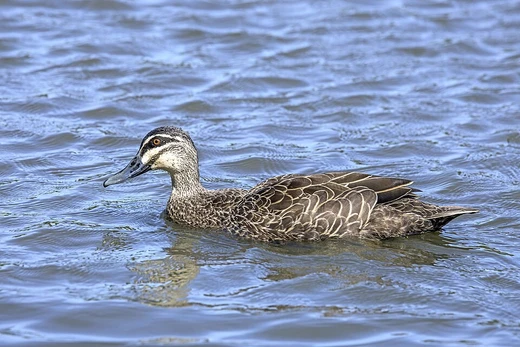
Pacific imperial pigeon
A frugivorous pigeon vital to Pacific island forest seed dispersal.
The Pacific imperial pigeon (Ducula pacifica) is a widespread pigeon species in the family Columbidae, found across numerous Pacific islands including American Samoa, the Cook Islands, Fiji, Kiribati, Niue, Papua New Guinea, Samoa, Solomon Islands, Tokelau, Tonga, Tuvalu, Vanuatu, and Wallis and Futuna Islands. It is also known as the Pacific pigeon, Pacific fruit pigeon, or lupe. The species was formally described in 1789 by German naturalist Johann Friedrich Gmelin and is now placed in the genus Ducula, introduced in 1836 by English naturalist Brian Houghton Hodgson.
- Scientific name
- Ducula pacifica
- Family
- Columbidae
- Length
- 36–41 cm (14–16 in)
- Weight
- 370–420 g (13–15 oz)
- Subspecies
- Two: D. p. sejuncta and D. p. pacifica
- Conservation status
- Least concern (IUCN)
- Primary diet
- Frugivorous
Lore & Background
The Pacific imperial pigeon was first described in 1789 by Johann Friedrich Gmelin in his expanded edition of Carl Linnaeus's Systema Naturae, based on a description by English ornithologist John Latham from the Friendly Isles (Tonga). It is now classified under the genus Ducula, a name derived from the Latin for 'leader.' Two subspecies are recognized: D. p. sejuncta, found on islets off northern New Guinea and parts of the Bismarck Archipelago, and D. p. pacifica, ranging from the Louisiade Archipelago to the Solomon Islands, Fiji, Samoa, Tonga, Niue, and the Cook Islands.
This pigeon measures 36–41 cm in length and weighs 370–420 g. It has blackish-green back, tail, and wings; a light grey head and neck; a grey breast with a pinkish tinge; brown undertail coverts; a black bill with a knob on the upper mantle; and a red iris. Females are slightly smaller, and juveniles lack the bill knob and pink breast. The species inhabits tropical moist lowland forests on smaller islands and tropical moist montane forests on larger islands, and it travels between islands to forage, sometimes forming large flocks in fruiting trees.
Reader's Guide
The Pacific imperial pigeon is a frugivorous species that consumes fruit from many plant species—38 species across 24 families in a Tongan study—and occasionally leaves and flowers. It feeds in individual trees for 1–50 minutes, often traveling short distances between trees but occasionally crossing several kilometers of water to other islands. Because seeds are not digested or damaged, the pigeon serves as an important seed disperser for Pacific island forests.
Breeding pairs nest high in trees, building concealed, unlined, untidy twig nests, and typically lay a single egg, with both sexes incubating. The species has suffered from habitat loss and hunting, leading to local declines, but remains common over much of its range and is listed as least concern by the IUCN. It is most vulnerable on smaller islands. In Niue, the bird is called a lupe and is a local delicacy; although now protected, it is still hunted. Notably, no nests have ever been found in Niue, so their breeding location there remains unknown. Historically, in Tonga and Samoa, the pigeon was hunted with elaborate traps on stone platforms, and these hunts held considerable cultural significance.
Did You Know?
- The Pacific imperial pigeon was formally described in 1789 by Johann Friedrich Gmelin based on a description by John Latham from the Friendly Isles (Tonga).
- In a Tongan study, the pigeon consumed fruit from 38 plant species across 24 families.
- In Niue, the bird is called a lupe and is a delicacy, but no nests have ever been found there.
- The species is an important seed disperser because seeds pass through undigested.
More in Birds of the Pacific Ocean 1-24
Spotted an error? Know more?
This is a living reference — every entry is fact-audited, and reader corrections feed straight into our audit queue. Suggest an edit · See this site's audit record