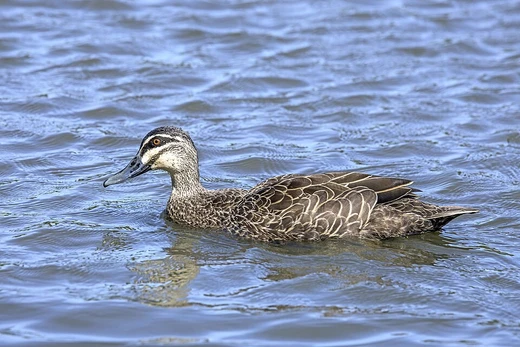
Pacific black duck
A dabbling duck threatened by hybridization with the introduced mallard.
The Pacific black duck (Anas superciliosa), also known as the grey duck or pārera in New Zealand, is a dabbling duck found across Indonesia, New Guinea, Australia, New Zealand, and many southwestern Pacific islands. It was formally described in 1789 by Johann Friedrich Gmelin based on a drawing by Georg Forster from James Cook's second voyage. The species is notable for its hybridization with the introduced mallard, which threatens its genetic identity in New Zealand and parts of Australia.
- Scientific name
- Anas superciliosa
- Common names
- Pacific black duck, grey duck, pārera
- Described by
- Johann Friedrich Gmelin (1789)
- Subspecies
- A. s. superciliosa, A. s. pelewensis
- Size
- 54–61 cm (21–24 in)
- Diet
- Mainly vegetarian, supplemented with small crustaceans, molluscs, and aquatic insects
- Conservation concern
- Declining due to hybridization and competition with mallards
Lore & Background
The species is a dabbling duck that feeds by upending, plunging its head and neck underwater. It nests in tree holes, old corvid nests, or occasionally on the ground, laying 8–10 pale cream eggs incubated solely by the female for 26–32 days. The precocial young leave the nest when dry and can fly at about 58 days. Its diet is mainly seeds of aquatic plants, supplemented with small crustaceans, molluscs, and aquatic insects. In New Zealand, it is known as the grey duck or pārera, and its range overlaps with the introduced mallard, leading to extensive hybridization. Studies of parasitic feather lice support predictions that the grey duck may lose its identity as a separate species in New Zealand, replaced by a hybrid swarm similar to the extinct Mariana mallard.
Reader's Guide
The Pacific black duck's significance lies in its role as a native waterfowl across a vast Pacific range and its ongoing conservation crisis due to hybridization with the introduced mallard. In New Zealand and several Australian islands, the species has declined sharply because of competition and interbreeding. Research indicates that mallard phenotype is dominant in hybrids, so plumage alone cannot determine ancestry. Overhunting in the mid-20th century also contributed to the grey duck's decline, making it more vulnerable to displacement by the larger, physically dominant mallard. The species' situation mirrors that of the now-extinct Mariana mallard, which likely originated from hybrids between the Pacific black duck and mallard. Understanding this dynamic is critical for conservation efforts, as the Pacific black duck's genetic integrity continues to erode. Its presence across diverse island ecosystems also makes it a key indicator of wetland health and the impacts of introduced species.
Did You Know?
- The Pacific black duck was described from a watercolor drawing by Georg Forster, made at Dusky Sound, New Zealand, during James Cook's second voyage.
- The specific epithet superciliosa means 'supercilious' or 'eye-browed', referring to its prominent eye-stripe.
- The now-extinct Mariana mallard was probably originally derived from hybrids between the Pacific black duck and the mallard.
- In New Zealand, the Pacific black duck is known as the grey duck or by its Māori name, pārera.
More in Birds of the Pacific Ocean 1-24
Spotted an error? Know more?
This is a living reference — every entry is fact-audited, and reader corrections feed straight into our audit queue. Suggest an edit · See this site's audit record